Eight generations, same water
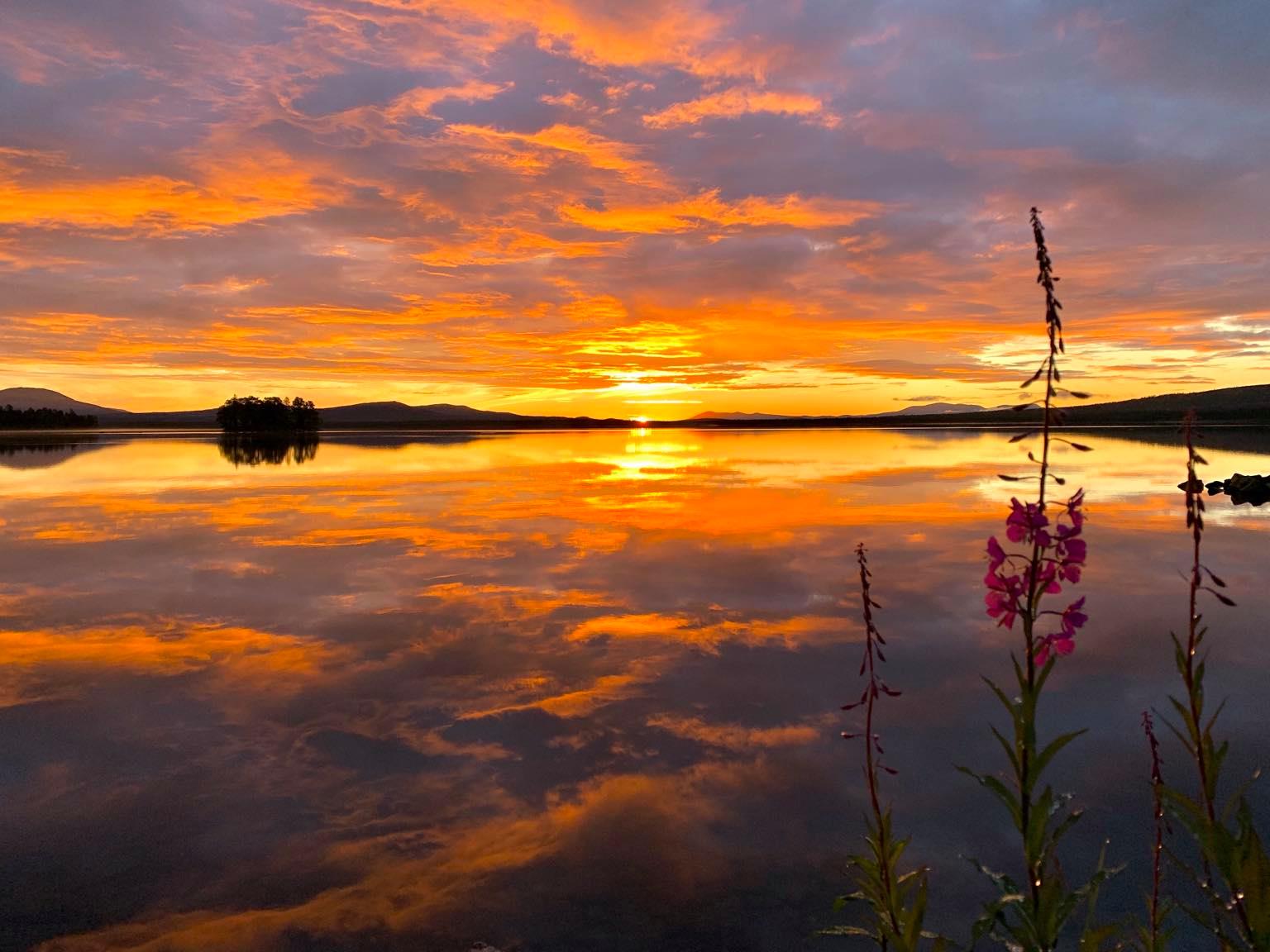
Fiskevollen on Sølensjøen is Norway’s only active inland fishing village. A 1913 archaeological find dated continuous fishing here to the 900s. Forty families still keep it going.
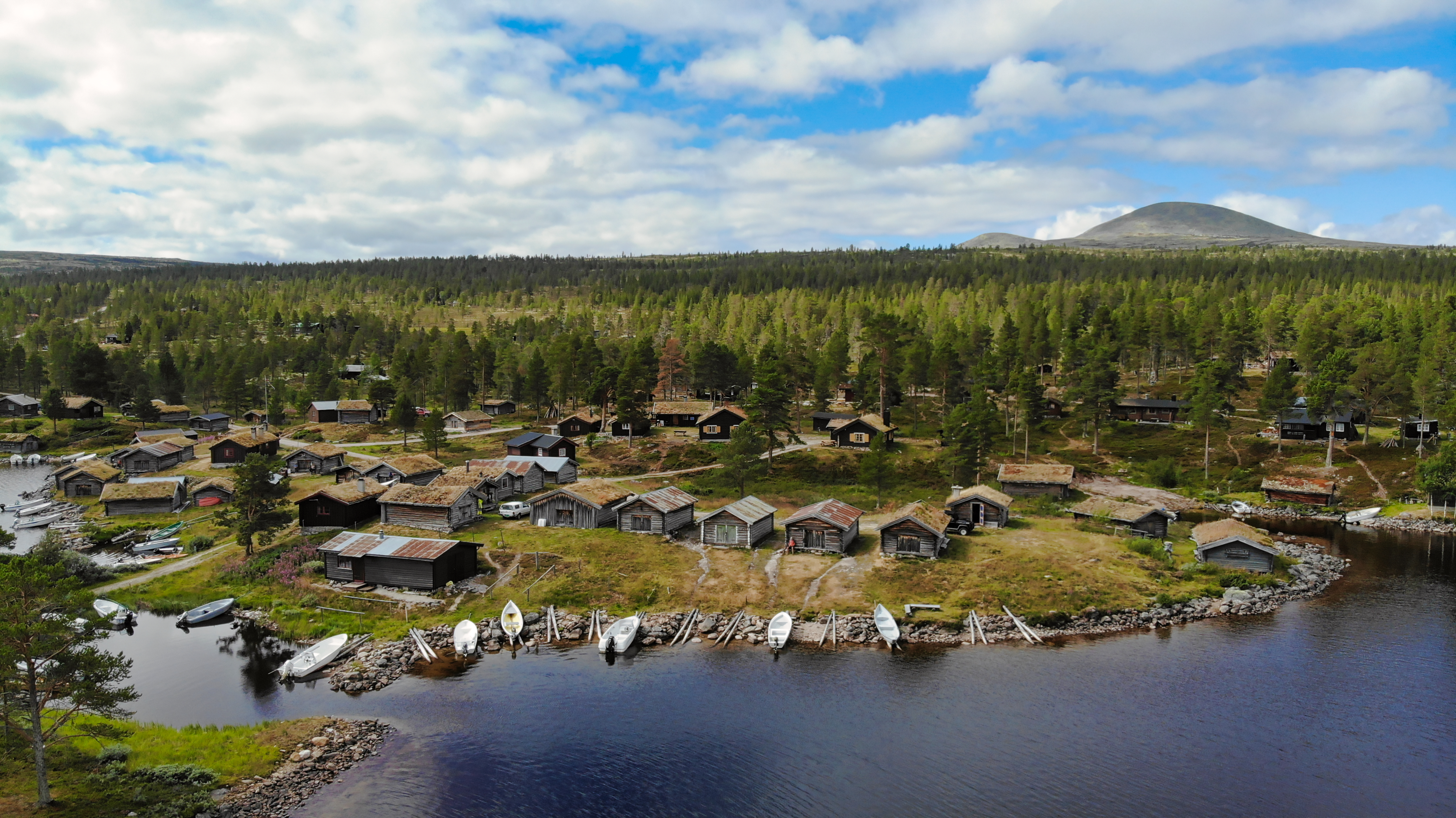
Drive thirty kilometres east from Bergset along Fv30, then turn onto a gravel road that snakes through pine forest for twenty minutes more. The trees open. You arrive at a lake the size of a small Mediterranean bay, and on its western shore stands a settlement of about eighty hand-hewn log buildings — boathouses at the water, cabins above them, gear cellars between. It looks like a village. It is a village. Nobody lives there year-round.
One of one in Norway
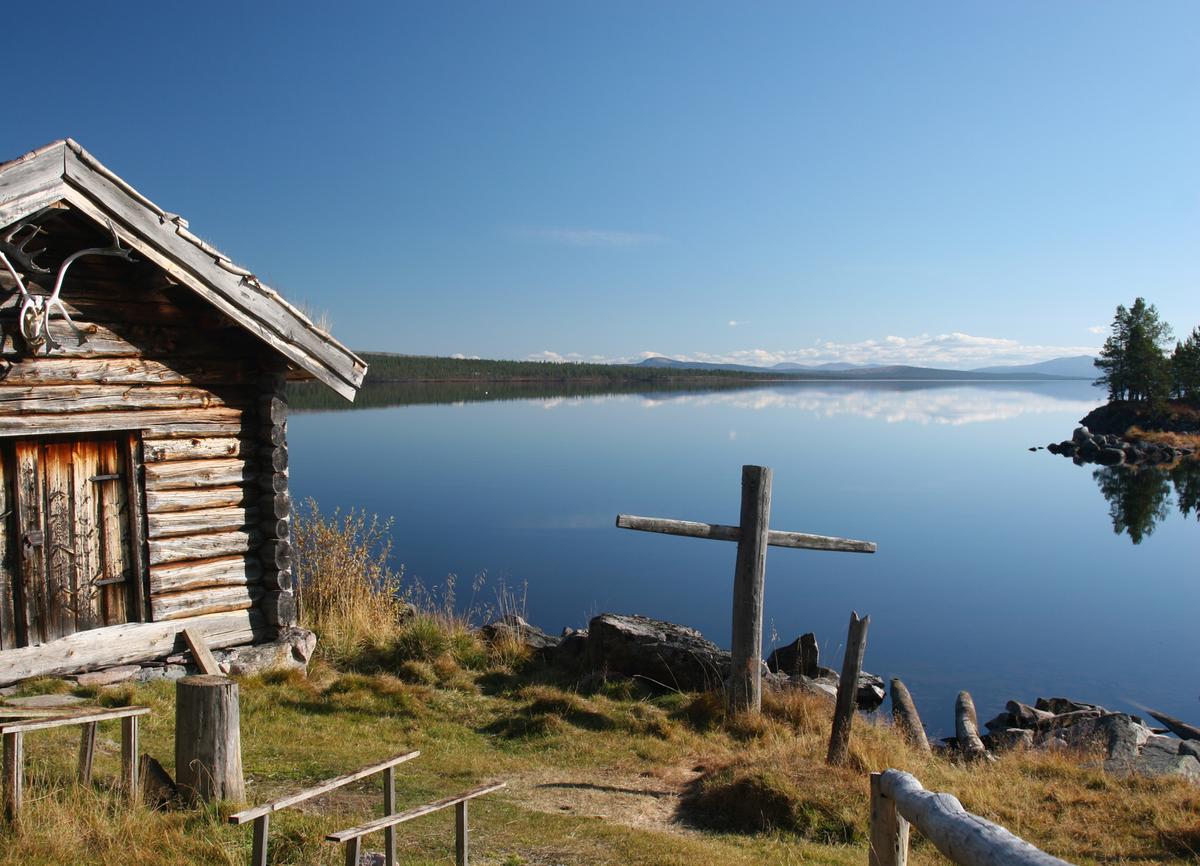
Fiskevollen sits on the western bank of Sølensjøen in Øvre Rendal. Norway has hundreds of fishing villages — «fiskevær» — strung along the coast, from the Lofoten archipelago down to Sørlandet. Fiskevollen is the only one inland, and the only one still in active commercial use as a fishing settlement. Store norske leksikon settles for the formal phrase: Norges eneste innlandsfiskevær. Locally the line is shorter: the only one of its kind in the country.
What the village fishes is what the lake has always offered — sik (whitefish) and røye (Arctic char). Around fifteen tonnes a year now, on average, gathered by gill net and traps and trucked out to the receiving station at Elgå. From there it leaves as rakfisk and hot-smoked sik, mostly sold inside Norway.
The net from the 900s
In 1913 an archaeologist working at Fiskevollen turned up a piece of fishing net. Carbon-dating eventually placed it in the 10th century. The same dig produced a complete set of Viking-age hunting equipment, and the soil beside the village still holds the footprint of a Stone-Age dwelling. People have been living off this water, at this exact spot, for more than a thousand years.
The Middle Ages added a legal layer. Fishing rights at Sølensjøen were granted to a handful of farms in upper Rendal — rights tied to the farm, passed by inheritance, treated as part of the property. By the time Røros Kobberverk owned the surrounding forest for charcoal in the 1700s, the fishing rights had stayed with the farms. They have stayed with the farms ever since.
A thousand years of catch
The 1913 find — a piece of fishing net dated to the 10th century — is one of the few hard-dated continuous-use sites in inland Norway. Most Viking-age fishing evidence is coastal. Sølensjøen is the inland exception.
About eighty buildings, three types
The village reads at a glance. Down at the waterline are the naust — open boathouses where the fishing boats are pulled up. Slightly above them, set into the slope, are the buer: small log cabins where the fisher sleeps during the season. Between and behind them are the kjeller or tjell — semi-buried gear cellars holding nets, salt, and barrels. Three building types, the same plan for centuries.
Construction is hand-hewn pine log, low to the ground, sun-bleached grey on the south sides and moss-dark on the north. A 1980 inventory recorded fifty-nine buildings. Today there are about eighty. The oldest verified ones date from the early 1700s; some structures may be older.
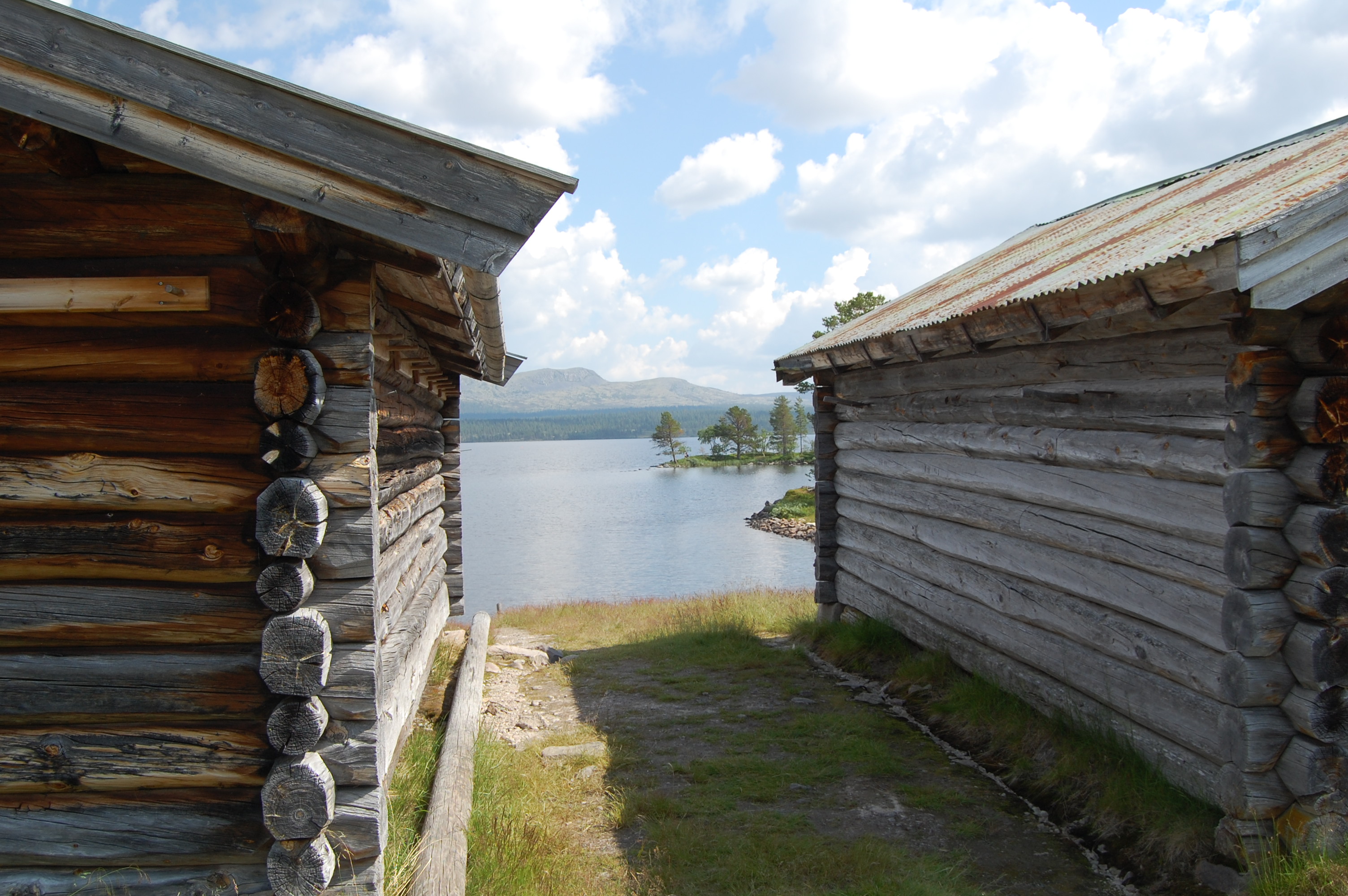
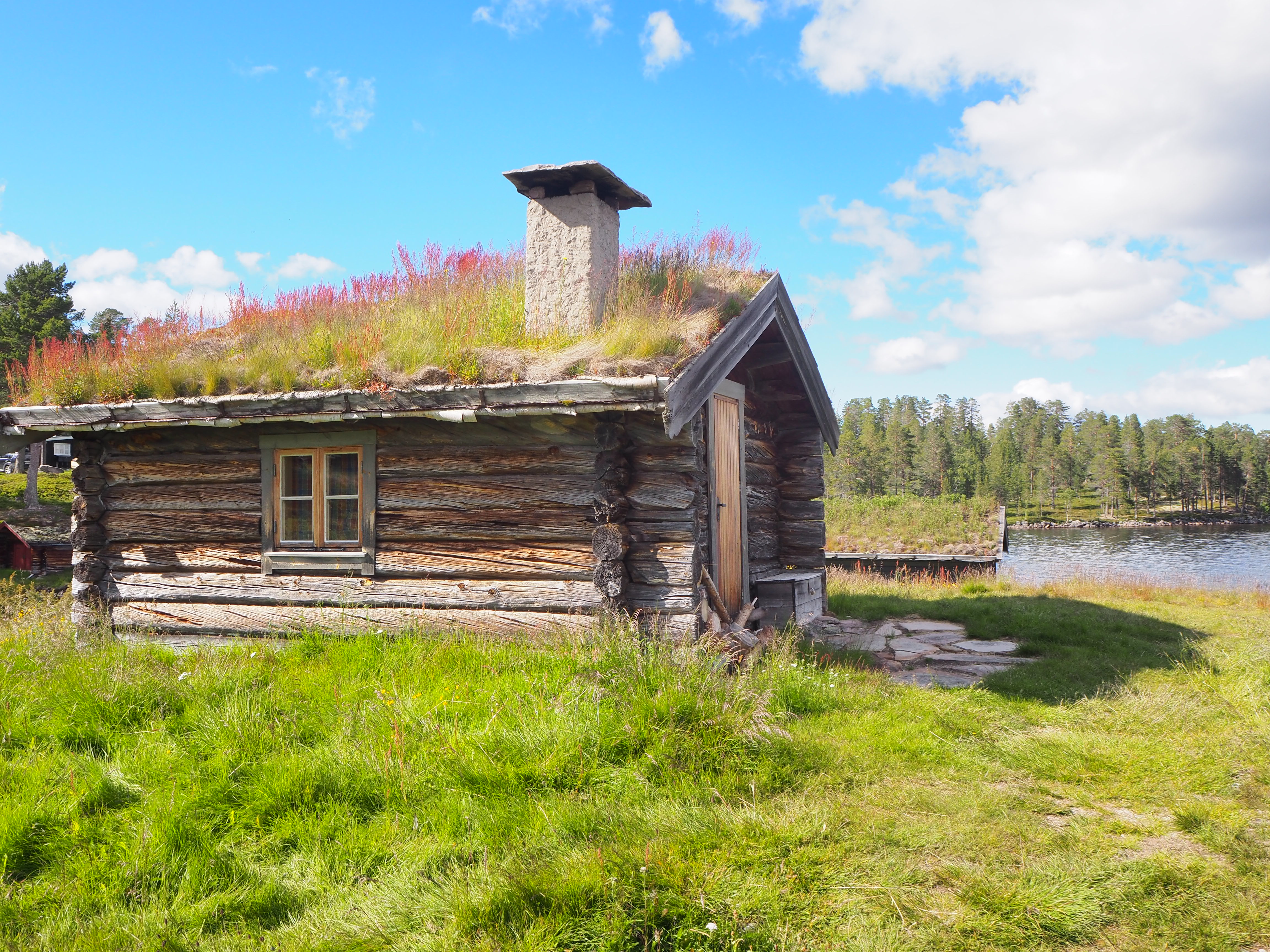
The buildings have always been owned individually rather than communally. Each rights-holding farm keeps its own bu and naust, repairs them as needed, and passes them on with the farm itself. Wood is brought up from the valley; replacement logs are hewn to fit the original notches.
The result is not preservation in the museum sense. The village has never stopped functioning. It is what conservators call «levende kulturmiljø» — a living cultural landscape.
The cooperative
The formal structure today is Sølensjøen Lotteierlag SA, a registered cooperative. The original grant put fishing rights in the hands of twenty farms. Generations of inheritance and subdivision have grown that to roughly forty rights-holders, each tied to one of the original farms. The lag manages the lake, the buildings, and the harvest as a single concern.
Restoration work on four communally-owned buildings — a tjell, two naust, and an old ljørbu converted into a community house — earned the cooperative the national Vernepris (conservation award) from Fortidsminneforeningen, the Norwegian National Trust, in June 2022. Project lead Dag Ådne Sandbakken put the credit half on the rights-holders and half on the craftsmen. The jury cited «the balance between expert conservation and practical repair work.»
The lake-kings
In every generation the cooperative has had a notbas — a master net-fisher who runs the big seasonal hauls. Locally the term that stuck is Sølensjøkongen, the king of Sølensjøen. It is not a formal title. It is what people called the person who happened to know the lake better than anyone else.
The first remembered Sølensjøkonge was Reodor Wardenær. Postwar, the title passed to Haagen Hangaard, who served as notbas for more than fifty years and who learned his craft directly from Wardenær. The teaching chain has held without break ever since the early decades of the 20th century.
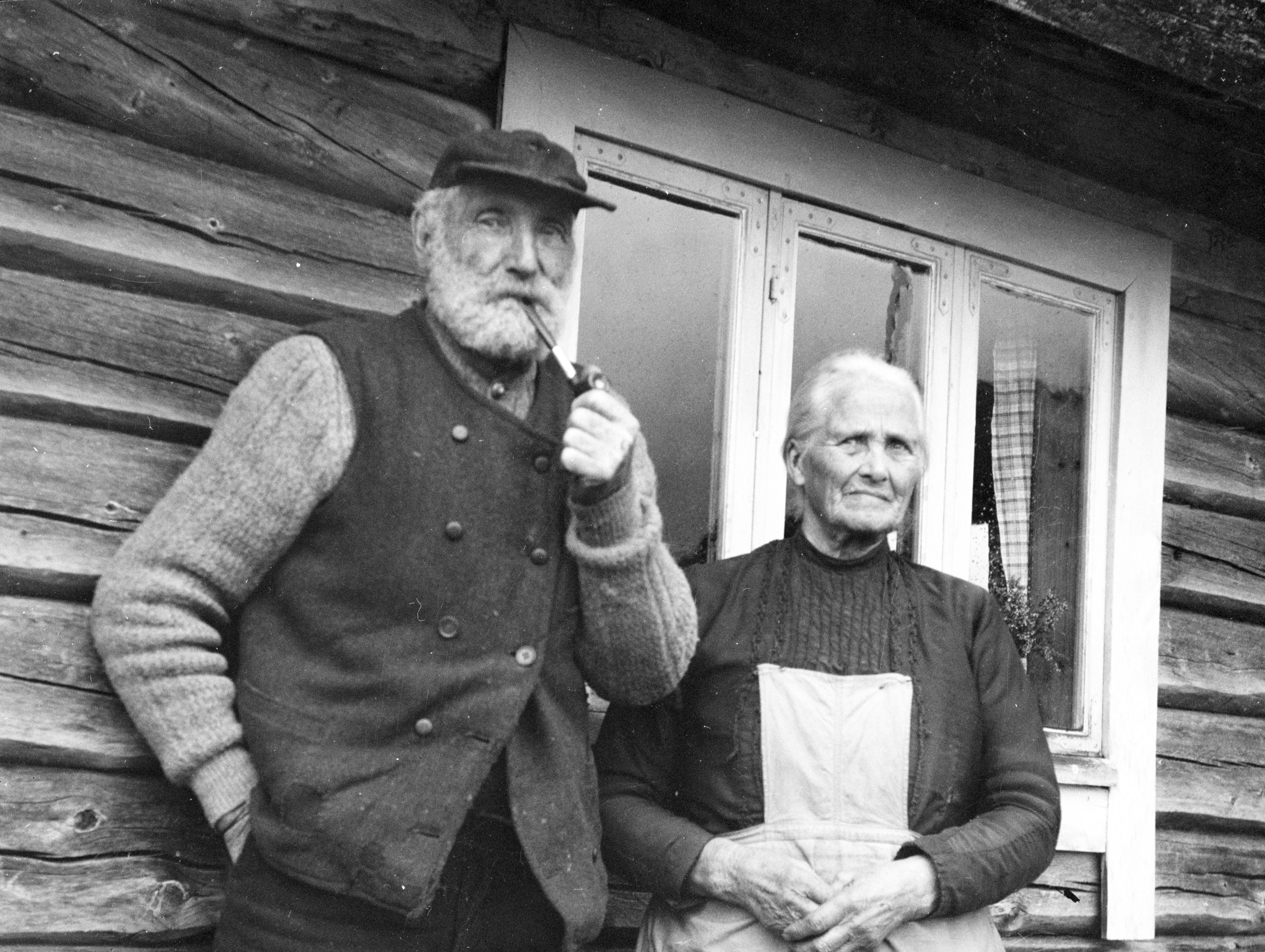
This is the only widely-published portrait of Wardenær — standing in his work clothes with a pipe, beside his wife Kristine, in front of the cabin where they stayed during the fishing season. It is undated; the clothes and the photographic style suggest somewhere between the 1920s and 1940s.
The chain of teaching is something the village itself is conscious of. Haagen Hangaard would tell visitors he had not invented anything about how Fiskevollen fishes — he had learned it from Wardenær, who had learned it from his elders, on this lake, in this season, with this kind of net.
How it works today
The fishing year still has two seasons. The summer harvest runs from St. Hans (24 June) through mid-July; the autumn røye fishery follows during the spawning run, mid-September to mid-October. The gear is largely the same as a century ago — gill nets in lengths up to a few thousand metres, and box-traps set in the shallows. The largest hauls historically used a great seine net, hauled by a team. The volume of catch today — somewhere between eleven and fifteen tonnes a season — is closer to a craft scale than an industrial one.
The catch goes by van down to the fish-processing station at Elgå. About half the volume becomes rakfisk — salted, fermented fish, a regional speciality — the rest leaves as cold- and hot-smoked sik, sold to delicatessens and markets across Norway. Almost none of it is exported.
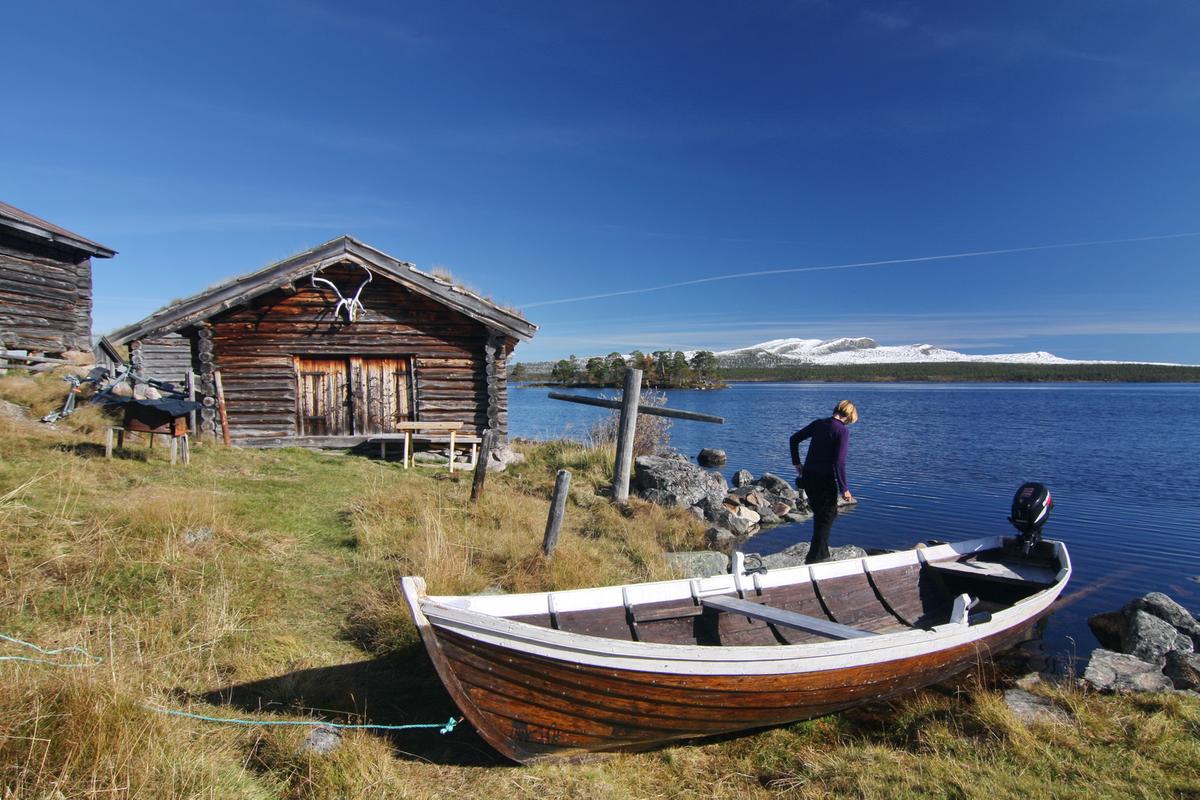
I’m the lucky one with two dream jobs. We are privileged to have access to a place like this.
— Hilde Mømb, who runs the village café and serves as the cooperative’s fishing inspector, in the regional newspaper Østlendingen
Mømb is a rights-holder. In summer she runs Vaktbua, the village’s small café and warden post, and serves as the cooperative’s fishing inspector. In winter she works as a freelance guide based in Cape Town. This is the third successive summer she has held the Vaktbua role. It serves coffee, hot-smoked whitefish from the lake, fresh pancakes, and what Vaktbua has become known for — sik-burgers, sold out by mid-afternoon on busy days.
The road and the day
The road into Fiskevollen was built between 1939 and 1941. Before that, in summer the gear and supplies came up on pack horses; in winter on sleds. The road is gravel and seasonal — it shuts in October, reopens in early June. Once it’s open the village is a thirty-kilometre drive from Øvre Rendal, the last twenty kilometres on dirt.
Vaktbua opens midday to four in the afternoon, from mid-June to mid-August. Once a year, late in July, the village holds Fiskevollendagen — an open-day festival that has drawn around eight hundred visitors in recent years. The cafe runs out of sik-burgers. Fishing permits, issued by the cooperative on-site and through inatur.no, cover both whitefish and char in season. From the village, a marked trail runs 7.8 km to the Haugsetvollen mountain pasture, with a stop at Karlshaugvollen on the way.
What it has, and what it doesn’t
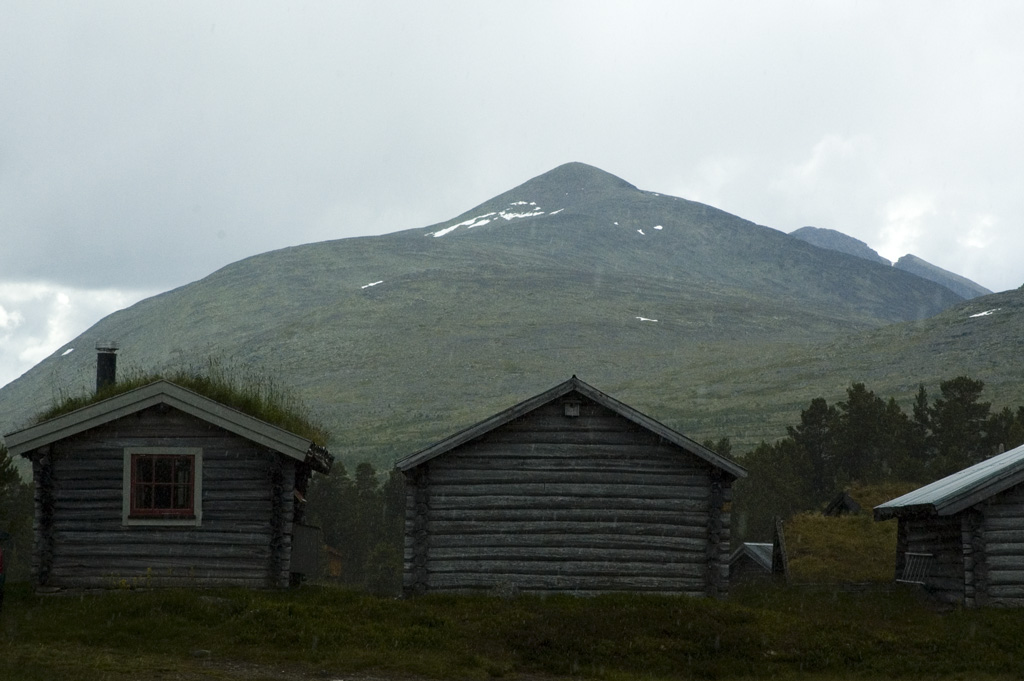
Fiskevollen is not formally protected under Norway’s heritage act. The national Directorate for Cultural Heritage lists it as a cultural environment of national interest — a designation that recognises the village’s significance without locking down what the cooperative can do with its own buildings. The surrounding Sølen, designated a protected landscape area in 2011, covers the wider terrain. Together with the 2022 conservation award, these are the formal acknowledgements the village has accumulated from outside.
The line that holds the village together is not a regulation. It is the inheritance — the farm that comes with a bu, the bu that comes with a notch in the cooperative, the notch that has been there since the Middle Ages. Forty households, one lake, a fishing season that runs by the same calendar as it has for centuries. The buildings get patched. The boats go out. The catch comes in.
Sources
- Store norske leksikon — Fiskevollen
- Norwegian Wikipedia — Fiskevollen
- Fiskevollen.no — Historie
- Opplev Rendalen — Fiskevollen
- Østlendingen — profile of Hilde Mømb at Vaktbua
- Fortidsminneforeningen — Vernepris 2022
- Byggmesteren — coverage of the Vernepris
- Riksantikvaren — Kulturmiljø av nasjonal interesse
- Digitalt Museum — historic photographs (search «Fiskevollen»)